
Your future may cost less than you think.
Money shouldn't keep you from exploring your options after high school. Financial aid can help pay for college, career training, and other education—and many families are surprised by how much help is available.
Start by completing the FAFSA to see what financial aid you may qualify for. Then explore scholarships, grants, and other ways to help pay for your education at the links below.
You don't have to figure it out alone. BACCAN can help you get started.
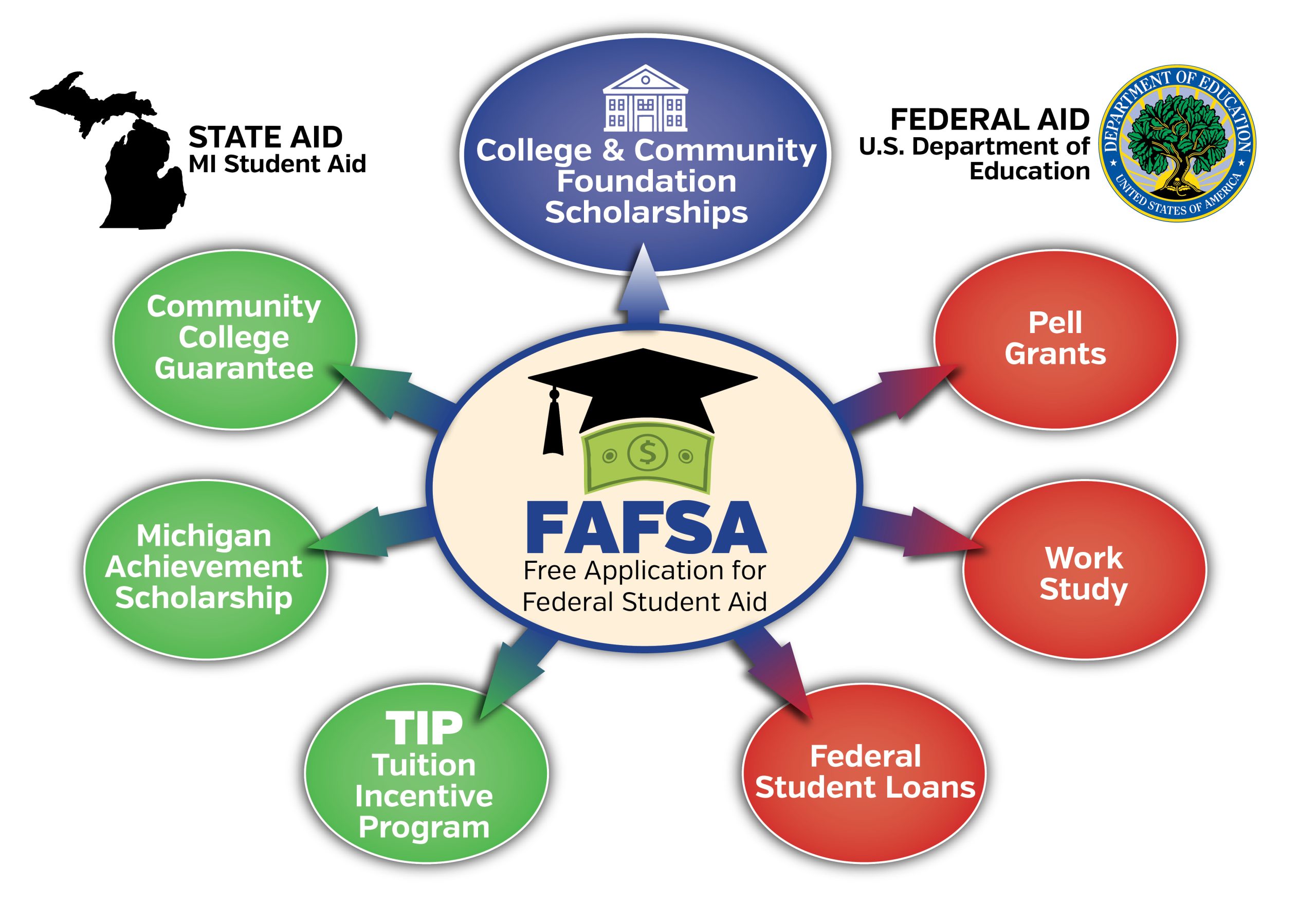
College and Community Foundation Scholarships
Local organizations, community foundations, colleges and universities award millions of dollars of scholarships from generous donors each year to help students pay for education after high school.
COMMUNITY:
The Bay Area Community Foundation (BACF) offers hundreds of scholarships for Bay and Arenac County students, including graduating seniors, current college students, adult learners, first-generation students, and students pursuing skilled trades or certificates.
Colleges and Universities:
Colleges also offer scholarships funded by alumni, families, businesses and other donors. Awards may be based on your grades, financial need, career plans, community involvement or other factors. Explore the options below to see what you qualify for.
Delta College Scholarships — Delta offers Foundation scholarships, the President's Honors Scholarship, transfer scholarships and more. More than 80% of applicants received a scholarship last year.
Saginaw Valley State University Scholarships — SVSU offers 1,000+ donor-funded scholarships, and one application determines which ones you qualify for.
Central Michigan University Scholarships — Includes scholarships for new and transfer students. CMU's Scholarship Universe can match you with donor-funded scholarships.
Davenport University Scholarships — Davenport offers merit and Foundation scholarships along with other gift aid.
Ferris State University Scholarships — ScholarshipUniverse can match you with 800+ Ferris donor-funded scholarships and outside scholarships.
Michigan State University Scholarships — MSU offers hundreds of scholarships, including scholarships open to all students and others for specific majors or programs.
Northwood University Scholarships & Grants — Includes scholarships for new and transfer students, plus private donor-funded scholarships.
University of Michigan Undergraduate Scholarships — Complete U-M's scholarship profile to be considered for available scholarships, including some donor-funded awards.
Don't see your college listed?
Search “[College Name] donor funded scholarships” to find scholarships from alumni, foundations and other donors. You can also try “[College Name] foundation scholarships” or “[College Name] endowed scholarships.”
COMMUNITY:
Colleges also offer scholarships funded by alumni, families, businesses and other donors. Awards may be based on your grades, financial need, career plans, community involvement or other factors. Explore the options below to see what you qualify for.
Colleges and Universities:
Colleges also offer scholarships funded by alumni, families, businesses and other donors. Awards may be based on your grades, financial need, career plans, community involvement or other factors. Explore the options below to see what you qualify for.
Delta College Scholarships — Delta offers Foundation scholarships, the President's Honors Scholarship, transfer scholarships and more. More than 80% of applicants received a scholarship last year.
Saginaw Valley State University Scholarships — SVSU offers 1,000+ donor-funded scholarships, and one application determines which ones you qualify for.
Central Michigan University Scholarships — Includes scholarships for new and transfer students. CMU's Scholarship Universe can match you with donor-funded scholarships.
Davenport University Scholarships — Davenport offers merit and Foundation scholarships along with other gift aid.
Ferris State University Scholarships — ScholarshipUniverse can match you with 800+ Ferris donor-funded scholarships and outside scholarships.
Michigan State University Scholarships — MSU offers hundreds of scholarships, including scholarships open to all students and others for specific majors or programs.
Northwood University Scholarships & Grants — Includes scholarships for new and transfer students, plus private donor-funded scholarships.
University of Michigan Undergraduate Scholarships — Complete U-M's scholarship profile to be considered for available scholarships, including some donor-funded awards.
Don't see your college listed?
Search “[College Name] donor funded scholarships” to find scholarships from alumni, foundations and other donors. You can also try “[College Name] foundation scholarships” or “[College Name] endowed scholarships.”
Get Funding: Aid from the Federal Government
Paying for college or career training can feel expensive, but you don’t have to pay for it all on your own. The federal government offers financial aid to help with the cost, including grants you don't have to pay back, work-study opportunities and student loans.
The first step is completing the FAFSA (Free Application for Federal Student Aid). Your FAFSA helps determine which types of federal financial aid you may qualify for.
Grants
Grants are money for school that you usually don't have to pay back.
Federal Pell Grant — Money for undergraduate students with financial need.
Federal Supplemental Educational Opportunity Grant (FSEOG) — Extra grant money for undergraduate students with exceptional financial need. Funding is limited and not every college participates.
TEACH Grant — Money for eligible students preparing to become teachers.
Work-Study
Federal Work-Study — Allows eligible students to earn money through a part-time job while attending school.
Federal Student Loans
Federal student loans are money you borrow and must pay back with interest. Your college will tell you which loans and how much you are eligible to borrow after you complete the FAFSA.
Direct Subsidized Loans — Loans for undergraduate students with financial need. The federal government pays the interest while you're enrolled at least half-time and during certain other periods.
Direct Unsubsidized Loans — Federal loans that don't require you to show financial need. Interest starts adding up once the loan is paid out.
PLUS Loans — Federal loans that can help parents of dependent undergraduate students pay education costs not covered by other financial aid.
Get Funding: Aid From the State of Michigan
Local organizations, community foundations, colleges and universities award millions of dollars of scholarships from generous donors each year to help students pay for education after high school.
The State of Michigan offers scholarships and grants to help students pay for college, community college and career training. Many programs use information from your FAFSA to determine whether you qualify.
Michigan Achievement Scholarship — Recent Michigan high school graduates can receive up to $5,500 per year for up to five years at Michigan colleges and universities. Students generally need an SAI of 30,000 or less.
Community College Guarantee — Recent Michigan high school graduates can attend their in-district community college tuition-free for up to three years. There is no income requirement to qualify, and Pell-eligible students can receive an additional $1,000 Michigan Achievement Bonus.
Michigan Achievement Skills Scholarship — Recent Michigan high school graduates can receive up to $2,000 toward an approved career-training program. There is no income or GPA requirement to begin receiving the scholarship.
Tuition Incentive Program (TIP) — Provides tuition assistance for students who met Michigan's Medicaid eligibility requirements. TIP can help pay for an eligible certificate or associate degree and provide additional assistance toward a bachelor's degree.
Michigan Competitive Scholarship — Need-based scholarship assistance for eligible Michigan students attending participating colleges. Awards can be up to $1,500 per year.
MI Scholarship Search — Looking for other State of Michigan scholarships? Search for additional scholarships connected to your Michigan school, county, city or region.

Get Funding: Completing the FAFSA
Your future may cost less than you think.
Local organizations, community foundations, colleges and universities award millions of dollars of scholarships from generous donors each year to help students pay for education after high school.
FAFSA Checklist
Get ready before you start. Gathering a few things ahead of time can make completing the FAFSA much easier.
- Determine whether you're a dependent or independent student
Most high school students are considered dependent students and will need information from a parent or other required contributor.
You may be considered an independent student if certain circumstances apply, such as being 24 or older, married, a veteran, supporting a child or dependent, having been in foster care after age 13, or experiencing homelessness.
- Information every student should have ready
☐ StudentAid.gov account — Create or access your account
☐ Social Security number, if applicable
☐ Permanent Resident Card, if applicable
☐ Required federal tax information
☐ Current checking and savings account balances
☐ Current value of investments, if required
☐ A list of colleges or schools you're considering
Each student needs their own StudentAid.gov account to complete the FAFSA.
- If you're a dependent student, gather parent information
Your parent(s) may need:
☐ Their own StudentAid.gov account — Create or access a parent account
☐ Social Security number or ITIN, if applicable
☐ Date of birth and email address
☐ Marital status
☐ Required federal tax information
☐ Current checking and savings balances
☐ Current investment information
☐ Other financial information requested on the FAFSA
Each required contributor needs their own StudentAid.gov account; students and parents should not share an account.
Not sure whose parent information to use?
The FAFSA has specific rules for parents who are married, remarried, divorced, separated or living apart. Don't guess—Federal Student Aid has a quick tool that can tell you which parent needs to participate.
Use the “Who’s My FAFSA Parent?” tool
Has something changed for your family?
Talk with the financial aid office at your college if your family's financial situation has changed significantly, you're experiencing homelessness, large medical expenses, or other major changes that aren't accurately reflected on your FAFSA. A college's financial aid office may be able to review your circumstances and adjust your aid eligibility.
College and Community Foundation Scholarships
Local organizations, community foundations, colleges and universities award millions of dollars of scholarships from generous donors each year to help students pay for education after high school.
COLLEGES and UNIVERSITIES:
Delta College Scholarships — Delta offers Foundation scholarships, the President's Honors Scholarship, transfer scholarships and more. More than 80% of applicants received a scholarship last year.
Saginaw Valley State University Scholarships — SVSU offers 1,000+ donor-funded scholarships, and one application determines which ones you qualify for.
Central Michigan University Scholarships — Includes scholarships for new and transfer students. CMU's Scholarship Universe can match you with donor-funded scholarships.
Davenport University Scholarships — Davenport offers merit and Foundation scholarships along with other gift aid.
Delta College Scholarships — Delta offers Foundation scholarships, the President's Honors Scholarship, transfer scholarships and more. More than 80% of applicants received a scholarship last year.
Saginaw Valley State University Scholarships — SVSU offers 1,000+ donor-funded scholarships, and one application determines which ones you qualify for.
Central Michigan University Scholarships — Includes scholarships for new and transfer students. CMU's Scholarship Universe can match you with donor-funded scholarships.
Davenport University Scholarships — Davenport offers merit and Foundation scholarships along with other gift aid.